Thursday, 6 October 2016

Short Film Audience Survey Results Analysis

The tables and graphs below display the statistics in a variety of different formats, for the responses to my quantitative audience research survey. The pie charts and bar graphs make it easier to visualise the distribution of the votes across each answer selection, whilst the data tables give more detailed information on the percentage of each chosen answer. Overall, 25 people took my survey.

Question 1- What age range do you fall into?


The majority of my survey participants said that they were 16 to 24 years old. The next most popular age range was 35 to 44. This suggests that my main target audience is young adults.

Question 2- What is your gender?


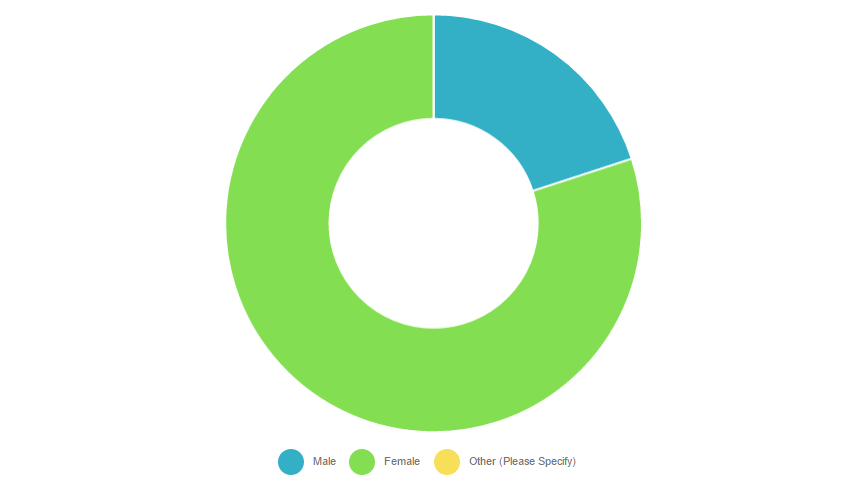
Most of the participants were female. Only 20% were male. This might suggest that I might be aiming my media product to a predominantly female audience.

Question 3- What is your ethnicity?


The large majority of my target audience have described themselves as white/Caucasian. As an ethnic majority group in the UK, this is unsurprising. This might suggest that my audience would relate less to a short film with issues surrounding race and discrimination.

Question 4- What is the highest qualification you have achieved?


Most people who completed this survey have achieved at least an AS level. Considering the main age group is 16 to 24, it might also suggest that they are still in education and hope to attain A levels or further. This suggests that my audience are fairly educated and intellectual.

Question 5- Where do you live?


Most of the participants live in and around Banstead, and very few live outside of Surrey. This might suggest that my target audience is local.


Question 6- What is your preferred social media?


The survey participants chose Facebook and Instagram together as their most preferred social media, followed closely by Twitter. These three social media platforms may be where I can find my target audience most successfully. Those who selected 'other' all put snapchat as their preferred social media.

Question 7- To what extent would you say you were film literate?
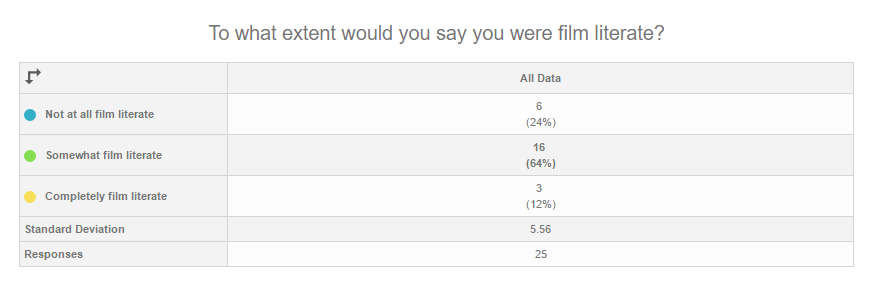


Most of the participants would call themselves somewhat film literate, if not more so. This suggests that I will be able to employ technical codes to create macro meaning to be inferred.

Question 8- Have you ever watched a short film?


Only two participants said that they have never watched a short film. This means that my target audience are familiar with the short form and will understand my final media product.

Question 9- What is your preferred genre of short?


The majority of participants said that comedy was their favourite genre of short was comedy, followed by social realism. This has given me an idea of the type of genre of short film that would be best received by my target audience.

Question 10- How many short films do you watch each month?


Most of my target audience watch 1-3 short films every month. This might suggest they only watch the well known ones that go 'viral'. However, it is not completely unlikely that they'll see my finished media product.


Question 11- Which service do you use most frequently?


The large majority of participants chose YouTube as their preferred media consumption platform. This might suggest that my target audience are better reached on YouTube compared to Vimeo, for example.

Question 12- What social groups do you prefer to see represented in media texts?
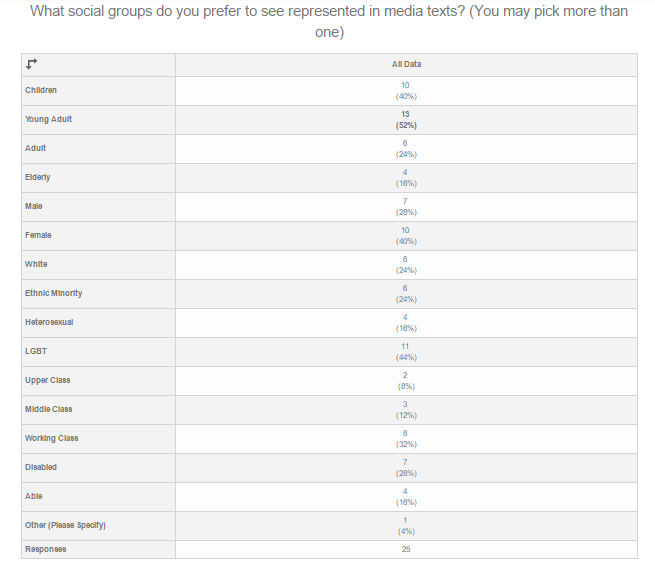


The most popular answer from each social type was: young adult, female, white/ethnic minority, LGBT, working class, and disabled. This suggests that my target audience agrees with the social realism convention of representing those that are commonly underrepresented in regular media texts.

Question 13- What issues do you like to see being represented in media texts?


The most popular answer for this question was crime, followed by sexuality, followed by discrimination and gender. This gives me a good idea of what my target audience is looking for in a short film.

To Conclude:

Overall, my target audience is fairly educated and intellectual inside and outside of the film industry. It is comprised of mainly young adults aged 16-24, whom live locally to Banstead. It is mostly white females that are likely to use either Facebook, Instagram or Twitter as their favoured social media. They sometimes watch short films and look for minority social groups being represented, as well as issues that include crime, sexuality, and discrimination.

To compare my predictions with the actual responses:
  • the majority of responses suggest that my target audience have completed AS levels or higher
  • most do fall into the 16 to 24 age group
  • most also do prefer to use Facebook or Twitter 
  • the majority of my target audience also prefer Instagram
  • most of the participants would like to see young adults being represented in media texts
  • the majority of responses do imply that my target audience is somewhat to completely film literate

Wednesday, 5 October 2016

Synopsis Draft One

Home time at a local Surrey primary school on a bright, winter's day. A young girl bursts out of the doors of her classroom and runs into her mother's arms. Her face lights up as she is handed a piece of paper with her daughter's masterpiece scrawled across one side. The pair walk across the playground and make their way back home, whilst happily chatting with one another about their days. As soon as the mother and daughter's house is in sight, the girl runs towards the front door and impatiently stands on the doormat in wait for it to open. Her mother scrambles through her bag in search for the keys, whilst her daughter loses her focus on getting inside and begins to wander around the front drive. She glances at the car and creeps behind it slowly, keeping her eyes fixed on her mother through the window, who continues to get her keys out of her bag. The girl's gaze wonders from her mother to her reflection in the car. She stares for a short while, and watches as she walks along the length of the two doors. Suddenly, her mother is at the door asking what she is doing. She replies to her in a carefree tone and walks through the door into the warm.

Wednesday, 28 September 2016

Sound Task

The following sound clip is a study on omnidirectional and unidirectional microphones. I learned beforehand that omnidirectional microphones are capable of picking up sound from a wider range than a unidirectional microphone, which can only pick up sound from the direction it is being pointed in.

For this task, both of the microphones I used were unidirectional, although I was still able to see and compare the difference between them. I used a stereo microphone built into a voice recorder, and a shotgun microphone in which I added to the voice recorder as an external piece of equipment. 

This way, I was able to learn how to add external microphones to build on my technical skills. The following clip shares five sounds recorded with both the stereo mic and the shotgun mic. The clips of the same sound play back to back to show the difference, with the stereo mic recording playing first, and then the shotgun mic recording right after.


The first sound that I recorded was of a door handle in use. The first clip sounds a bit higher in pitch than the second one. In my opinion, the second clip, recorded with the shotgun microphone gives a more accurate representation of what I could hear. 

The second sound is of a code lock being used. In the stereo microphone recording, there is sound picked up from the background, of voices. However, in the shotgun microphone the sound of the lock seems much more isolated because of the lack of background noise. 

The third sound is of a locker door closing and opening. Similarly to the previous clip, the sound recorded through the voice recorder's internal microphone seems to sound more muffled than the sound recorded through the shotgun microphone, which makes it sound much clearer.

The fourth sound is of a person clapping. Unlike the previous sounds, the internal mic on the voice recorder picked the clapping up much easier than the shot gun microphone could. This may have been due to several factors, such as being outside, or having held the shotgun microphone at an angle that was not optimum for picking up the sound.

The fifth sound is of a person talking. Likewise with this clip, the stereo microphone picked up the surrounding sound, including the wind. It is fairly clear, although the shotgun microphone only picks up the voice of the person speaking and is therefore more so than the internal mic.

Overall, the shotgun microphone is much more successful in capturing singular sounds that need to be heard clearly. However, it is largely dependent on whether the mic is angled correctly on how well it is recorded. The internal stereo microphone, on the other hand, is good for recording multiple sounds coming from the same direction.

Wednesday, 21 September 2016

Short Film Audience Research Survey

The following images are screenshots from my online based quantitative audience research survey. I used the same screen shots to turn it into a paper based survey as well, in order to reach the largest and most diverse audience possible.


Short Film Audience Research Predictions

I was interested to see what my understanding of my target audience was like prior to the survey, so I made a few predictions based on the questions and answer choices that I included. Here are the following hypotheses:

I think that the majority of my target audience will:
  • have completed AS levels or higher
  • fall into the age group 16 to 24
  • prefer to use either Facebook or Twitter
  • prefer to see young adults being represented in media texts
  • say that they are somewhat or completely film literate
Once I receive responses from both my online and my paper surveys, I will collate the data and analyse it along with these predictions.

Tuesday, 20 September 2016

Primary Quantitative Research Brainstorm

The following mind map states my initial thoughts on carrying out primary quantitative target audience research.

Wednesday, 14 September 2016

Textual Analysis and Milgrom Theory Application: Unleaded (2015)

Short Film #3: Unleaded
Director: Luke Davies
Issues: Drug Abuse, Crime, Poverty, Working Class
Themes:  Theft, Misinterpretation,

Parallel editing has been used to create comedic effect in this short, which also helps the audience to better understand the narrative. This suggests to the audience that the switch to and from the two scenes is creating meaning by implying they are connected and that the drug addicts will meet the thugs as the narrative of the film progresses. This links the characters together, and being in the same place may emphasise the result of them both practicing illegal activity. This therefore, supports the issue of crime.
Furthermore, the editing style may exaggerate the protagonist’s point of view within the short. Long takes justify the use of ellipsis in the narrative, to keep the audience from getting bored, as well as to mimic the effect that drugs have on the mind of the protagonist. Long takes might emphasise delayed reactions and lack of awareness in his surroundings, whilst ellipsis may make clear his inability to recall recent events or understanding of time. This ties in with the issue of drug abuse.


The non-diegetic sound creates verisimilitude, which allows the audience to see the issues and themes surrounding poverty and low economic status, specifically the dialogue. The scene inside the shops allows audiences to hear the vulgar language and tone of voice used, which may be associated with working class social groups. Whilst the protagonist uses this language and angry manner too, as it creates an arguably more effective opposition between him and the thugs, the companions that he drove to the petrol station with take on a contrasting tone of voice. When cutting from a scene in their car to a scene in the shop, the pair in the car seem very relaxed and somewhat spaced out compared to the angry men in the shop. Levi Strauss’ ‘binary opposition’ theory may be applied here, as their accents also appear to be different to those trying to rob the shop, which might create an opposition between regionalities. This is supported by the fact that their friend, who speaks in similar tone to the thugs, also argues with them whilst he’s in the shop.


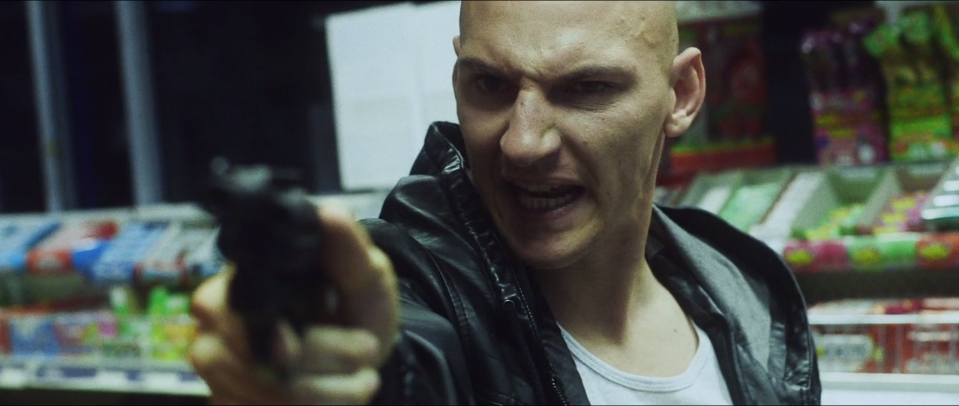
Camerawork creates contrast between the two groups that have pulled up at the petrol station and the mood that is created because of it. The woman in the car on her own is portrayed using much closer shots as compared to the two men in the car. This emphasises her contemplation and worry as she waits for the other two antagonists to finish thieving the shop and to leave. The two men in the car are often seen in a two shot, which requires a wider shot to fit them into. This helps to exaggerate their body language and the fact that they are under the influence of drugs. This creates a lighter mood compared to the female in the neighbouring car, especially as one shot shows her face through the interior mirror, which may emphasise how aware she has to be to stay out of trouble, which conflicts with the two males laid back appearance and mood. Furthermore, the influence of drugs and lack of awareness is shown through the male protagonist’s close up in the shop, in which the main thug holding a gun is depicted in the shallow focus in the background. This highlights his lack of awareness and supports the issue of drug use.


The binary opposition between low key and high key lighting may represent the confidence and independence that each of the characters have. Inside the shop is portrayed as having high key lighting, and as being visible to those outside in the dark. This is an exposed area and seems that only some are willing to enter it. This might exaggerate the confidence that these individuals bear to be able to walk inside. The dark area might represent the unknown and perhaps even foreshadows the shooting of the woman towards the end. This is because she spends most of the film hidden in the outside area of the petrol station, yet decides to walk in, perhaps based on what she sees from the car pulled up next to hers, which might not have been clear to her and led her to misunderstanding. The low key lighting outside therefore draws attention to the obscurity of the events happening inside. This supports the theme of misinterpretation.


Marilyn Milgrom’s The Script may be applied to Unleaded, as it has a world, a character, and a problem. The world for this short is the petrol station. The character is the protagonist who has entered the petrol station shop in search for food. His problem is that his friends are unsympathetic and force him into the petrol station to buy them food. Little does he know, he is also being held at gunpoint. Milgrom also states that one of three things must drive the character through the narrative; a want, a need, or an obligation. In this case, the man’s want to find something to eat is what drives the narrative forward. She also makes a point that it is important to make the end of the film meaningful by choosing the best point of view to tell the story from. This short film portrays the protagonist as the best point of view, as he creates the comedic effect through the way that he talks to his friends and supposedly the thug, and his lack of awareness of the whole event.