Wednesday, 12 October 2016

Synopsis Draft Two

Upon my feedback session, I was told some positives and some point to improve on from my first draft of the synopsis. My tutor told me that according to Milgrom's theory, I needed to make my problem clearer, and increase the stakes. 

I agreed to stay with the initial set up of the girl running out of her classroom into a crowd of parents, although I have now edited the rest to set the story up without the mother figure being there. I thought of several diverse scenarios in which the girl runs out in order to find her, to see that she has not turned up:

  1. The girl attempts to walk home by herself, seeing several different social issues, and visualising them in an imaginative, exaggerated and childlike way
  2. She goes back to her classroom and plays with the role play whilst waiting for her mum
  3. She goes back to her classroom and finds the dressing up- she role plays her mother in dressing and acting like her in her attempt to care for herself in her absence
I have written these out as potential endings for the first half of my synopsis:

  1. Home time at a local Surrey primary school on a bright, winter's day. A young girl bursts out of the doors of her classroom clutching a sheet of paper with her masterpiece on it. Her face drops as her eyes, unfocused, scan the crowd of parent figures. After a short while, she ceases her search and fixes her gaze onto her classroom door. The girl, young and alone, makes in the opposite direction towards the gate. She sheepishly walks around the corner and out of the sight of adults. On her walk, she passes a group of young adults smoking cigarettes. Fear fills her face as she moves on, leaving plenty of clearance as she walks around them. The girl proceeds on her journey into the park, which she finds to be desolate. Moments after she reaches the other side, she stops in her tracks and stares up towards the tall, dark trees looming over her. Shutting her eyes and blocking her ears, she runs through the short stretch and ends up on a road. She smiles to herself as she acquaints herself with the pavement, and walks more confidently towards the houses in front of her. Her calm facial expression soon fades as a car slows next to her, barely passing as she continues walking. She reaches a driveway. She rings on the doorbell, and the door opens.                                                                                                                                                                                                                                                * I plan to envision the girl's imagination as she reaches each landmark in her journey, in a way that shows the real thing compared with what she makes of it, almost giving the effect of a double take.                                                                                                                                                                                                                                                                                                                          
  2. Home time at a local Surrey primary school on a bright, winter's day. A young girl bursts out of the doors of her classroom clutching a sheet of paper with her masterpiece on it. Her face drops as her eyes, unfocused, scan the crowd of parent figures. After a short while, she ceases her search and fixes her gaze onto her classroom door. Still holding onto her picture, she moves back into the warm, dragging her feet as she goes. The girl sits on a basic reception chair in wait for someone to get her. Despite reassurance from her teachers, she tires from sitting tight and begins to wonder. Showing no sense of urgency or worry, the girl passes from classroom to classroom. She enters her own, and walks into the role play area. It has been decorated to look like a room of a house. She sits and plays and pretends and chatters to herself, uninterrupted, immersed in her own game. As time passes and no one shows up, the girl shows no sign of stopping. Meanwhile, two children are playing with a dolls house, one of them complaining about the whereabouts of the mum figurine.                                                                                                                                                                                                                       
  3. Home time at a local Surrey primary school on a bright, winter's day. A young girl bursts out of the doors of her classroom clutching a sheet of paper with her masterpiece on it. Her face drops as her eyes, unfocused, scan the crowd of parent figures. After a short while, she ceases her search and fixes her gaze onto her classroom door. Still holding onto her picture, she heads back inside with reluctance. As she enters the classroom, she immediately drops her things in search for something else to preoccupy herself with. Striding over to the other side of the room, she picks out a box from a cupboard, and pulls out a plethora of fancy dress costumes. Out of the abundance of princess dresses and other colourful outfits, she settles for a woolen jumper, a scarf, and a handbag. Immersed in her own thoughts, she wonders the classroom looking at the walls plastered in childish scrawl, and occasionally stops to admire her own. Still carrying her hand bag, she proceeds on her journey through the school until she ends up at the kitchen. She potters around until she finds something to eat. She continues with her pretend game by pressing buttons and twisting dials. She manages toast, and with pride, she takes her meal and sits in the school's dining room to eat it.

Tuesday, 11 October 2016

Poster Brainstorm: Neds (2010)

I participated in a peer activity, in which we were given several prompts as 'legs' of our spider diagram, and left to brainstorm thoughts on the poster of NEDS, released in 2010 by Peter Mullan. This was useful in setting us all up to analyse several film posters in full.


An Introduction to Posters

To accompany my short film, I also need to produce a poster to promote it. I have made notes on points to consider.

Connotation: Imagery and symbols carry connotations - it is important to choose the right colours, symbols and shapes to convey the intended meaning

Anchorage: For example, a caption anchors a picture, and vice versa

Preferred reading/ Negotiated reading/ Oppositional reading

Tone: The overall impression gained from human communication is 70% non verbal, 23% tone, and only 7% actual words

Register: vocab, style and grammar. Consider the many degrees of formality; man, guy, bloke

Intertextual and intermedial references: Shows awareness of wider media context

Target audience: to be kept in mind

Representation: the portrayal of groups in society- be prepared to discuss the seven areas of representation; values and ideologies

Effect and effectiveness: research using surveys, focus groups, polls and through finding sales figures etc

How to read a film poster: the film's style, title, colour /colour saturation, certificate, costume, props, iconography, intertextual references, positive/negative space, context, font, shape, texture

Thursday, 6 October 2016

Short Film Audience Survey Results Analysis

The tables and graphs below display the statistics in a variety of different formats, for the responses to my quantitative audience research survey. The pie charts and bar graphs make it easier to visualise the distribution of the votes across each answer selection, whilst the data tables give more detailed information on the percentage of each chosen answer. Overall, 25 people took my survey.

Question 1- What age range do you fall into?


The majority of my survey participants said that they were 16 to 24 years old. The next most popular age range was 35 to 44. This suggests that my main target audience is young adults.

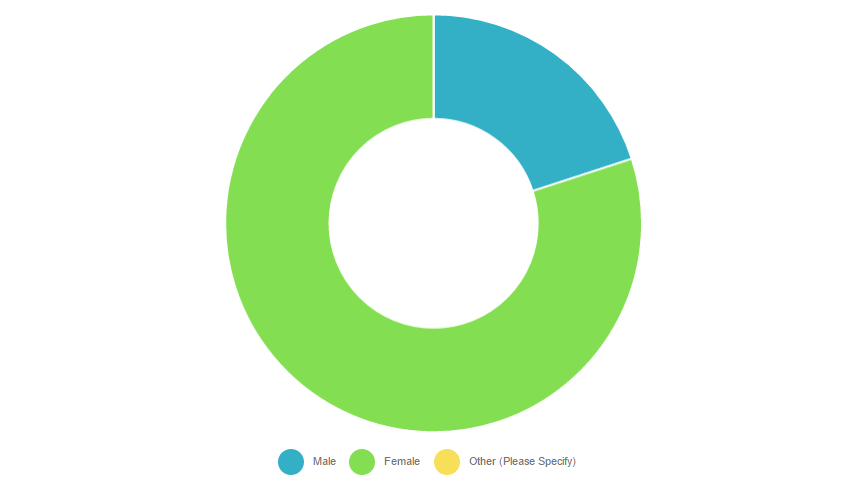
Question 2- What is your gender?


Most of the participants were female. Only 20% were male. This might suggest that I might be aiming my media product to a predominantly female audience.

Question 3- What is your ethnicity?


The large majority of my target audience have described themselves as white/Caucasian. As an ethnic majority group in the UK, this is unsurprising. This might suggest that my audience would relate less to a short film with issues surrounding race and discrimination.

Question 4- What is the highest qualification you have achieved?


Most people who completed this survey have achieved at least an AS level. Considering the main age group is 16 to 24, it might also suggest that they are still in education and hope to attain A levels or further. This suggests that my audience are fairly educated and intellectual.

Question 5- Where do you live?


Most of the participants live in and around Banstead, and very few live outside of Surrey. This might suggest that my target audience is local.


Question 6- What is your preferred social media?


The survey participants chose Facebook and Instagram together as their most preferred social media, followed closely by Twitter. These three social media platforms may be where I can find my target audience most successfully. Those who selected 'other' all put snapchat as their preferred social media.

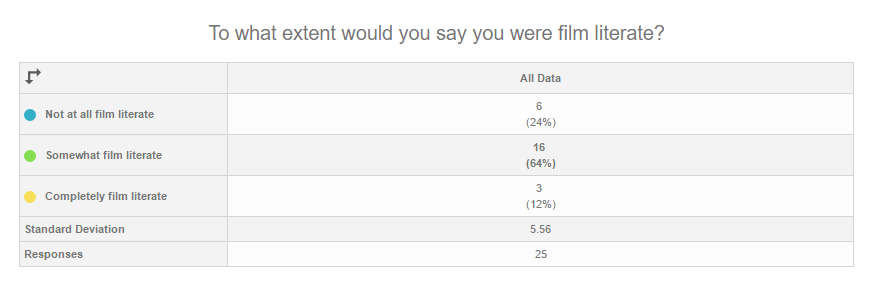
Question 7- To what extent would you say you were film literate?


Most of the participants would call themselves somewhat film literate, if not more so. This suggests that I will be able to employ technical codes to create macro meaning to be inferred.

Question 8- Have you ever watched a short film?


Only two participants said that they have never watched a short film. This means that my target audience are familiar with the short form and will understand my final media product.

Question 9- What is your preferred genre of short?


The majority of participants said that comedy was their favourite genre of short was comedy, followed by social realism. This has given me an idea of the type of genre of short film that would be best received by my target audience.

Question 10- How many short films do you watch each month?


Most of my target audience watch 1-3 short films every month. This might suggest they only watch the well known ones that go 'viral'. However, it is not completely unlikely that they'll see my finished media product.


Question 11- Which service do you use most frequently?


The large majority of participants chose YouTube as their preferred media consumption platform. This might suggest that my target audience are better reached on YouTube compared to Vimeo, for example.

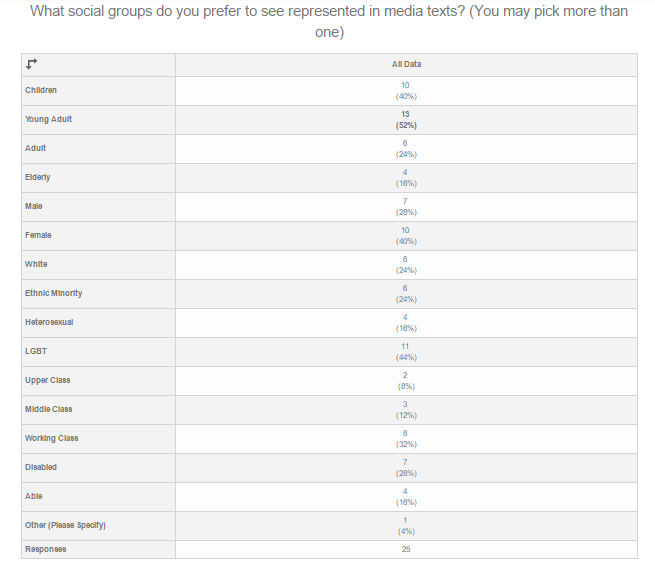
Question 12- What social groups do you prefer to see represented in media texts?


The most popular answer from each social type was: young adult, female, white/ethnic minority, LGBT, working class, and disabled. This suggests that my target audience agrees with the social realism convention of representing those that are commonly underrepresented in regular media texts.

Question 13- What issues do you like to see being represented in media texts?


The most popular answer for this question was crime, followed by sexuality, followed by discrimination and gender. This gives me a good idea of what my target audience is looking for in a short film.

To Conclude:

Overall, my target audience is fairly educated and intellectual inside and outside of the film industry. It is comprised of mainly young adults aged 16-24, whom live locally to Banstead. It is mostly white females that are likely to use either Facebook, Instagram or Twitter as their favoured social media. They sometimes watch short films and look for minority social groups being represented, as well as issues that include crime, sexuality, and discrimination.

To compare my predictions with the actual responses:
  • the majority of responses suggest that my target audience have completed AS levels or higher
  • most do fall into the 16 to 24 age group
  • most also do prefer to use Facebook or Twitter 
  • the majority of my target audience also prefer Instagram
  • most of the participants would like to see young adults being represented in media texts
  • the majority of responses do imply that my target audience is somewhat to completely film literate

Wednesday, 5 October 2016

Synopsis Draft One

Home time at a local Surrey primary school on a bright, winter's day. A young girl bursts out of the doors of her classroom and runs into her mother's arms. Her face lights up as she is handed a piece of paper with her daughter's masterpiece scrawled across one side. The pair walk across the playground and make their way back home, whilst happily chatting with one another about their days. As soon as the mother and daughter's house is in sight, the girl runs towards the front door and impatiently stands on the doormat in wait for it to open. Her mother scrambles through her bag in search for the keys, whilst her daughter loses her focus on getting inside and begins to wander around the front drive. She glances at the car and creeps behind it slowly, keeping her eyes fixed on her mother through the window, who continues to get her keys out of her bag. The girl's gaze wonders from her mother to her reflection in the car. She stares for a short while, and watches as she walks along the length of the two doors. Suddenly, her mother is at the door asking what she is doing. She replies to her in a carefree tone and walks through the door into the warm.

Wednesday, 28 September 2016

Sound Task

The following sound clip is a study on omnidirectional and unidirectional microphones. I learned beforehand that omnidirectional microphones are capable of picking up sound from a wider range than a unidirectional microphone, which can only pick up sound from the direction it is being pointed in.

For this task, both of the microphones I used were unidirectional, although I was still able to see and compare the difference between them. I used a stereo microphone built into a voice recorder, and a shotgun microphone in which I added to the voice recorder as an external piece of equipment. 

This way, I was able to learn how to add external microphones to build on my technical skills. The following clip shares five sounds recorded with both the stereo mic and the shotgun mic. The clips of the same sound play back to back to show the difference, with the stereo mic recording playing first, and then the shotgun mic recording right after.


The first sound that I recorded was of a door handle in use. The first clip sounds a bit higher in pitch than the second one. In my opinion, the second clip, recorded with the shotgun microphone gives a more accurate representation of what I could hear. 

The second sound is of a code lock being used. In the stereo microphone recording, there is sound picked up from the background, of voices. However, in the shotgun microphone the sound of the lock seems much more isolated because of the lack of background noise. 

The third sound is of a locker door closing and opening. Similarly to the previous clip, the sound recorded through the voice recorder's internal microphone seems to sound more muffled than the sound recorded through the shotgun microphone, which makes it sound much clearer.

The fourth sound is of a person clapping. Unlike the previous sounds, the internal mic on the voice recorder picked the clapping up much easier than the shot gun microphone could. This may have been due to several factors, such as being outside, or having held the shotgun microphone at an angle that was not optimum for picking up the sound.

The fifth sound is of a person talking. Likewise with this clip, the stereo microphone picked up the surrounding sound, including the wind. It is fairly clear, although the shotgun microphone only picks up the voice of the person speaking and is therefore more so than the internal mic.

Overall, the shotgun microphone is much more successful in capturing singular sounds that need to be heard clearly. However, it is largely dependent on whether the mic is angled correctly on how well it is recorded. The internal stereo microphone, on the other hand, is good for recording multiple sounds coming from the same direction.

Wednesday, 21 September 2016

Short Film Audience Research Survey

The following images are screenshots from my online based quantitative audience research survey. I used the same screen shots to turn it into a paper based survey as well, in order to reach the largest and most diverse audience possible.